


Why Reading Still Matters in a Distracted World
Last week, National Read a Book Day encouraged people to do something wonderfully simple: pick up a book and read.
In a world dominated by artificial intelligence, productivity apps, wearable technology, social media feeds, and an endless stream of information, celebrating reading may seem almost nostalgic. After all, we have more ways than ever to consume information.
Yet neuroscience suggests that reading remains one of the most powerful activities we can engage in to support brain health, cognitive performance, emotional intelligence, and lifelong learning.
As organizations search for ways to improve focus, resilience, creativity, and workplace well-being, perhaps it's time to revisit one of the simplest and most accessible tools available:
A book.
The Modern Workplace Has an Attention Problem
Today's professionals are expected to process an extraordinary amount of information. Emails arrive around the clock. Notifications interrupt concentration. Meetings consume calendars. News updates, social media platforms, text messages, and digital communication tools compete constantly for our attention.
The result is a workforce that is often mentally exhausted before the day is over. Many employees describe feeling busy all day but struggle to find time for deep thinking. Leaders face increasing pressure to make important decisions while navigating environments characterized by constant distractions and information overload.
The challenge isn't a lack of information. It's a lack of uninterrupted attention.
Attention has become one of the most valuable cognitive resources in the workplace, yet it is also one of the most heavily taxed.
Reading offers a unique opportunity to strengthen that resource. Unlike scrolling through fragmented online content, reading requires sustained focus. The brain must follow ideas, remember details, connect concepts, and remain engaged over time.
In many ways, reading exercises the very cognitive abilities that modern work demands but modern technology often disrupts.
Reading
Is
a
Full-Brain
Workout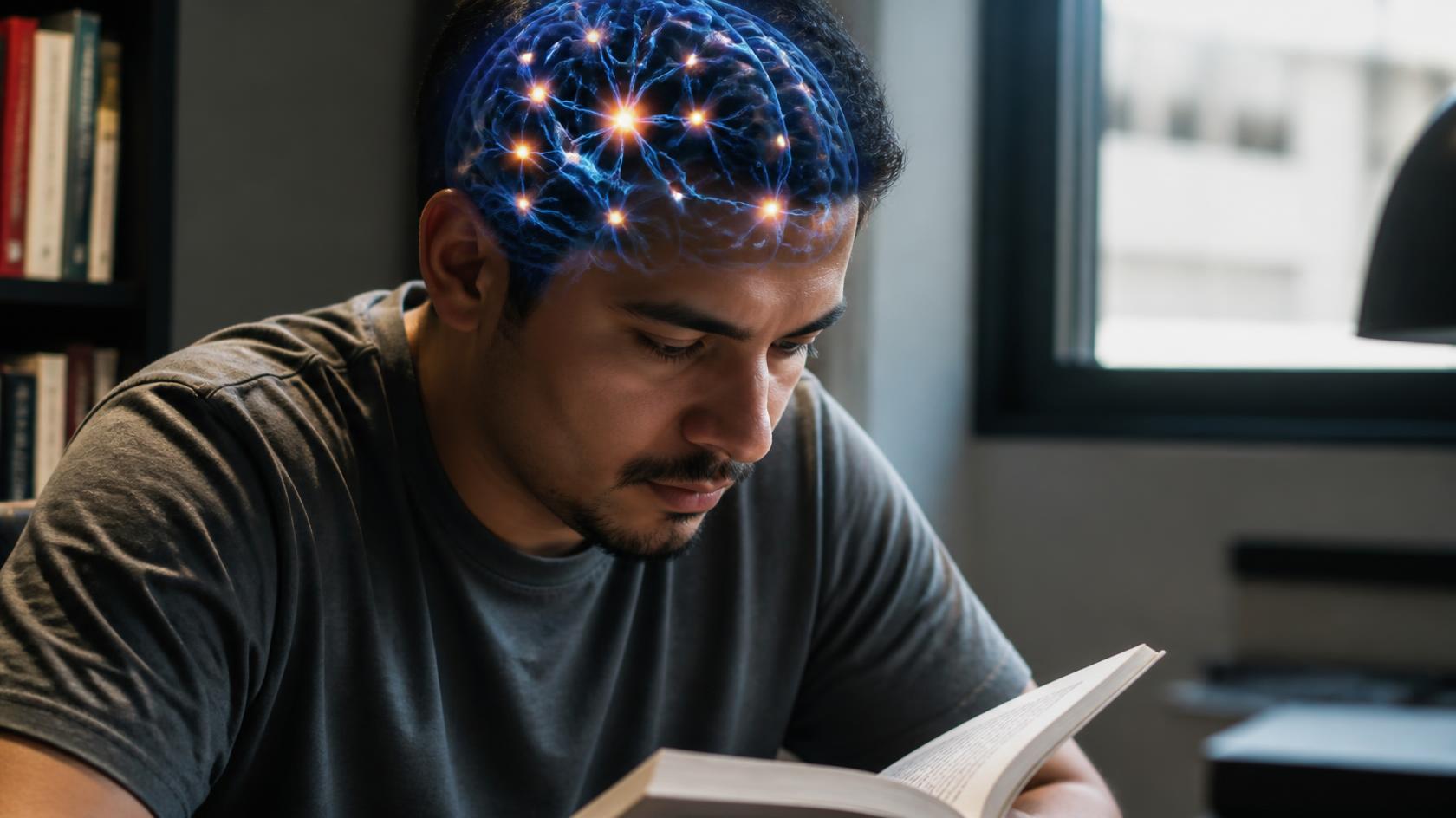
Many people think of reading as a language activity. Neuroscience tells a different story.
When we read, multiple brain regions become active simultaneously. Networks involved in language processing, memory, attention, reasoning, visualization, and emotional understanding all work together to create meaning from words on a page.
As you read, your brain is constantly translating symbols into language, creating mental images, connecting information to prior knowledge, predicting outcomes, and interpreting emotions and context.
This is one reason reading is such a powerful cognitive exercise. The brain operates according to a simple principle: the networks we use regularly become stronger and more efficient.
Every time we read, we challenge our brains to learn, analyze, imagine, interpret, and comprehend. These activities help reinforce neural pathways that support thinking and learning. Just as physical exercise strengthens muscles, reading strengthens the neural networks that support cognitive performance.
For professionals, this means reading is doing more than increasing knowledge. It is helping maintain and strengthen the mental systems responsible for communication, decision-making, problem-solving, and critical thinking.
Reading Builds Cognitive Resilience
Resilience is often discussed from an emotional perspective. We talk about managing stress, recovering from setbacks, and adapting to change. But there is also a cognitive side of resilience.
The human brain has an extraordinary ability to adapt and reorganize itself throughout life. Neuroscientists call this neuroplasticity. Every new skill, experience, and learning opportunity has the potential to strengthen existing neural pathways and create new ones.
Reading supports this process. Books expose us to new ideas, perspectives, experiences, and information. They challenge our assumptions and encourage us to think in different ways.
Over time, these mental challenges contribute to what researchers call cognitive reserve. Cognitive reserve refers to the brain's ability to remain adaptable, efficient, and resilient when facing challenges, stressors, and age-related changes.
In a workplace where change has become constant, adaptability is one of the most valuable skills a person can possess. Reading helps build that adaptability by continually expanding how we think and what we know.
Reading Helps Develop Empathy
One
of
the
most
overlooked
benefits
of
reading
may
be
its
ability
to
strengthen
empathy.
Successful workplaces depend on human connection. Leaders need to understand their teams. Employees need to collaborate effectively. Organizations need people who can communicate, solve problems, and work together despite differing perspectives.
Reading (especially fiction) can help develop these skills. When we read stories, our brains often simulate the experiences of characters. We imagine their motivations, emotions, challenges, and decisions. In essence, we practice seeing the world through someone else's eyes.
Research has found that reading fiction may strengthen perspective-taking and social understanding, helping readers better recognize emotions and understand different viewpoints. These abilities directly influence workplace relationships, leadership effectiveness, collaboration, and team culture.
Empathy is often referred to as a soft skill. In reality, it is a critical human skill. And books can help us develop it.
Reading as a Form of Mental Recovery
Many workplace wellness conversations focus on sleep, exercise, nutrition, and stress management. All of these are essential for brain health. But reading deserves a place in that conversation as well.
Unlike many forms of digital media consumption, reading encourages focused engagement rather than constant stimulation. When we become immersed in a book, the brain shifts away from reacting to multiple inputs and instead concentrates on a single experience. That shift can feel restorative. Not because the brain stops working, but because it begins working differently.
Reading allows us to temporarily step away from workplace demands, unfinished tasks, and digital distractions. For many people, this creates a sense of calm and mental clarity that is increasingly difficult to find in today's always-connected world. Sometimes recovery isn't about doing nothing. Sometimes it's about engaging the brain in a healthier way.
Why Reading Matters for Leaders
Great leaders are lifelong learners. While books can certainly provide knowledge and expertise, their value extends far beyond information. Reading expands perspective.
It exposes us to new ideas, different cultures, historical lessons, innovative solutions, and alternative ways of thinking. Whether the book is a biography, a leadership book, a novel, or a history text, reading helps leaders see beyond their own experiences.
This broader perspective often leads to better decision-making, stronger communication, greater adaptability, and increased empathy.
Leadership development doesn't always happen in workshops, conferences, or coaching sessions. Sometimes it happens one chapter at a time.
Carrying the Habit Beyond National Read a Book Day
National
Read
a
Book
Day
may
be
over,
but
the
opportunity
remains. The
brain
benefits
of
reading
don't
disappear
when
the
holiday
ends.
In fact, consistency matters far more than quantity. You don't need to read for hours each day to experience benefits.
- Ten minutes during a lunch break.
- A chapter before bed.
- Listening to an audiobook during a commute.
- Joining a workplace book club.
- Sharing recommendations with colleagues.
Small habits practiced consistently can have a significant impact over time.
The Bottom Line
Organizations spend considerable time searching for innovative ways to improve performance, learning, resilience, and well-being. Innovation certainly has its place. But sometimes the most effective solutions are also the simplest.
Reading strengthens attention in a distracted world. It supports learning in a rapidly changing world. It builds empathy in a disconnected world. And it helps develop the cognitive resilience needed to navigate an increasingly complex future.
National Read a Book Day may be behind us, but perhaps the real lesson is this: The next chapter doesn't have to wait until next year.
Every page we read is an investment in a healthier, stronger, more adaptable brain.
