


Why Connection Matters for Leaders: What the Brain Tells Us
Great leadership is often associated with strategy, decision-making, and results. But neuroscience shows that one of the most powerful tools a leader has is something much simpler: human connection. Our brains are wired for interaction. The way leaders communicate, listen, and build relationships directly affects how people think, perform, and respond under pressure.
Connection
Activates
Better
Thinking
When people engage in meaningful conversation and collaboration, several areas of the brain activate at once, memory, attention, language processing, and emotional regulation. In a workplace setting, this kind of engagement keeps teams mentally sharp and more capable of solving complex problems. Leaders who encourage dialogue and participation help keep these neural systems active and resilient.
Strong Relationships Reduce Workplace Stress
Work naturally involves pressure and deadlines, but supportive leadership can change how the brain processes stress. Positive relationships and psychological safety lower cortisol levels, the hormone associated with chronic stress. When cortisol stays elevated for too long, it can interfere with concentration, memory, and decision-making. Leaders who foster trust and support help protect their teams from these effects.
Belonging
Improves
Team
Performance
When people feel included and valued, the brain responds differently. Regions associated with motivation, reward, and emotional stability become more active. For leaders, this means that creating a culture of belonging is not just a cultural initiative, it has real cognitive benefits. Teams that feel connected tend to be more resilient, collaborative, and engaged.
Social Engagement Builds Cognitive Strength
Interaction challenges the brain in dynamic ways. Discussions, brainstorming sessions, and collaborative problem-solving strengthen mental flexibility and build what scientists call cognitive reserve; the brain’s capacity to stay sharp over time. Leaders who encourage active participation are not just improving meetings, they are strengthening the thinking capacity of their teams.
Positive Leadership Influences Brain Chemistry
Supportive
interactions
trigger
the
release
of
dopamine
and
oxytocin.
These
neurochemicals
are
associated
with
motivation,
trust,
and
overall
well-being.
When
leaders
communicate
with
empathy,
recognize
contributions,
and
build
authentic
relationships,
they
help
create
an
environment
where
people
are
more
motivated
to
contribute
their
best
work.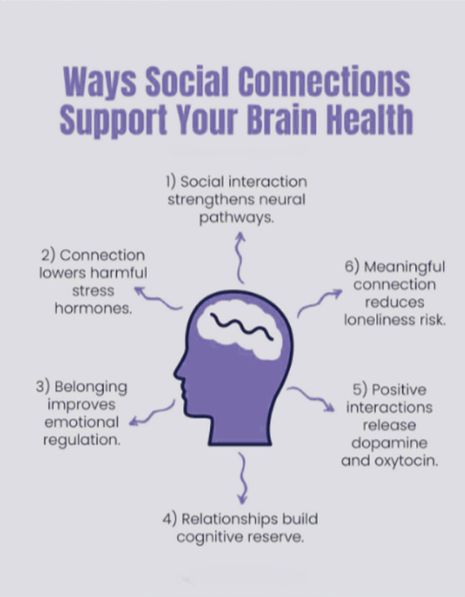
Six Brain-Based Reasons Connection Matters at Work
For leaders, prioritizing connection can have measurable impact:
- Strengthens neural pathways involved in focus, communication, and problem-solving.
- Reduces stress hormones that impair decision-making.
- Improves emotional regulation and resilience across teams.
- Builds cognitive reserve that supports long-term performance.
- Boosts motivation through dopamine and trust through oxytocin.
- Reduces isolation, which is linked to lower engagement and poorer well-being.
Leadership Starts With Human Connection
In fast-moving organizations, it’s easy to focus only on productivity and outcomes. But the brain thrives in environments where people feel seen, heard, and supported. Leaders who intentionally build connection are not just improving culture, they are enabling better thinking, healthier teams, and more sustainable performance.
Sometimes the most powerful leadership strategy is simply creating space for people to connect.
-Julie "Brain Lady" Anderson