


Why Brain Health May Be the Most Important Leadership Investment Your Organization Isn't Making
In today's workplace, leaders face unprecedented demands.
They are expected to navigate uncertainty, inspire teams, manage change, drive innovation, maintain productivity, and make high-stakes decisions, all while balancing increasing workloads and constant connectivity.
Organizations invest heavily in leadership development, employee engagement initiatives, strategic planning, technology, and productivity tools to help leaders meet these expectations. Yet one of the most powerful drivers of leadership effectiveness often remains overlooked:
Brain health.
The reality is that every leadership competency (from communication and emotional intelligence to decision-making and resilience) is dependent upon the health and performance of the brain. Without a healthy brain, even the most talented leaders can struggle to perform at their full potential. As organizations look for sustainable ways to improve performance, reduce burnout, and strengthen workplace culture, brain health deserves a place at the center of the conversation.
The Brain Behind Every Leadership Decision
Leadership is fundamentally a cognitive activity. Every day, leaders are required to process large amounts of information, prioritize competing demands, manage emotions, solve problems, adapt to changing circumstances, and guide others through uncertainty.
These responsibilities depend heavily on the brain's executive functions, which include:
- Strategic thinking
- Planning and organization
- Emotional regulation
- Attention and focus
- Decision-making
- Problem-solving
- Adaptability
- Working memory
When these cognitive functions are operating effectively, leaders tend to communicate more clearly, think more creatively, and make better decisions.
When brain health declines, however, these same skills often become compromised. Leaders may find themselves struggling with concentration, experiencing increased stress, reacting emotionally instead of thoughtfully, or feeling mentally exhausted by tasks that once felt manageable.
Unfortunately, many organizations interpret these symptoms as performance problems rather than indicators of cognitive overload. The distinction matters. Because if the root issue is brain health, traditional performance interventions may only address the symptoms rather than the cause.
The Four Pillars of Sustainable Success
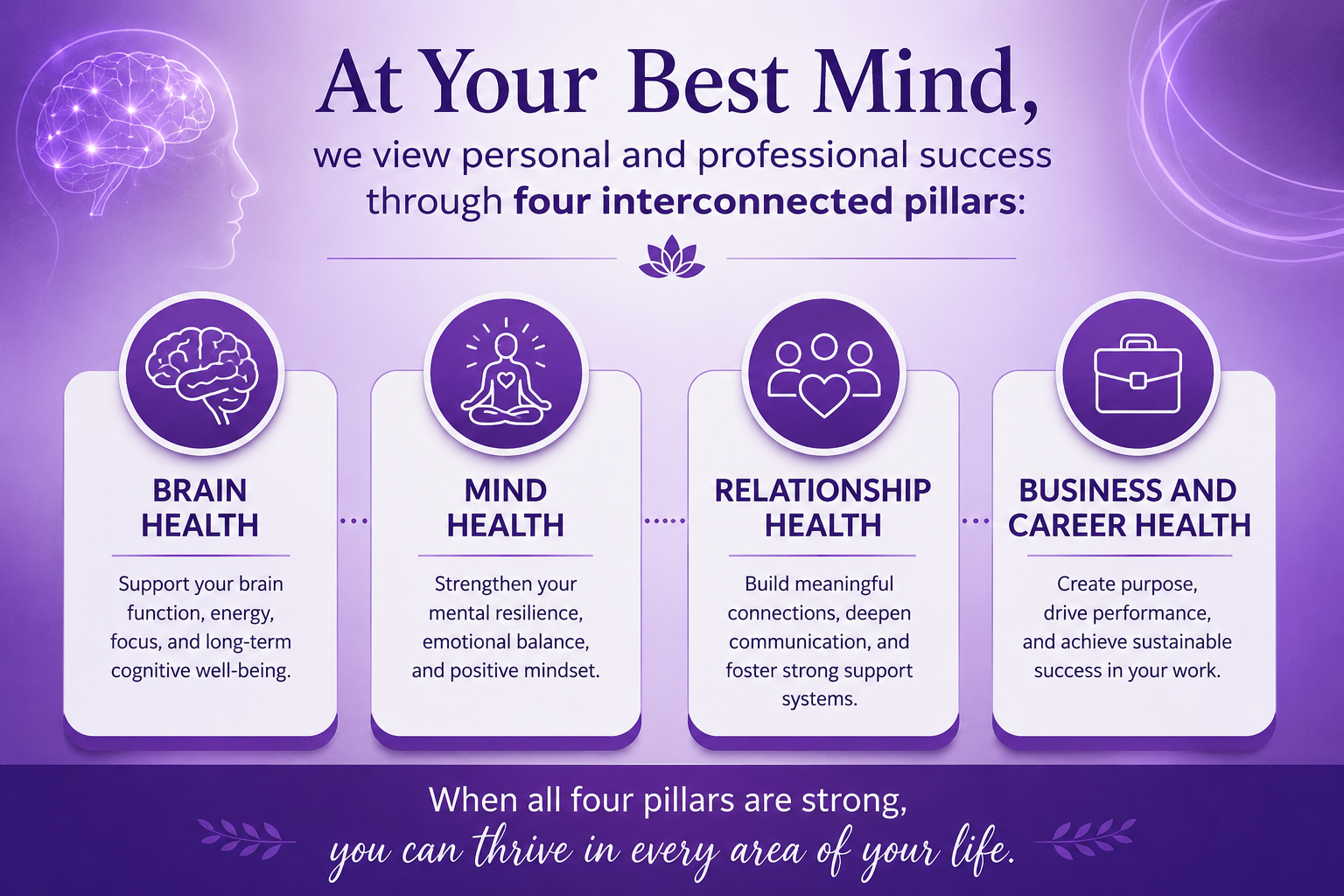
At Your Best Mind, we teach that sustainable success is built on four interconnected pillars:
 Brain
Health
Brain
Health
The foundation that supports all cognitive and emotional functioning.
Mind Health
The quality of our thoughts, mindset, emotional patterns, and mental habits.
Relationship Health
The strength of our personal and professional connections.
Business and Career Health
Our ability to perform, lead, achieve goals, and create meaningful success.
Many organizations focus heavily on the fourth pillar while neglecting the first three.
Yet the reality is that business performance is often a reflection of what is happening beneath the surface.
When brain health improves, individuals are better equipped to manage stress, build relationships, solve problems, and contribute at a higher level.
The reverse is equally true. When brain health suffers, every other pillar becomes more difficult to maintain.
The Hidden Leadership Crisis: Chronic Sleep Deprivation
If there is one factor that consistently undermines workplace performance, it is inadequate sleep. Sleep deprivation has become normalized in many professional environments. Late-night emails, early-morning meetings, packed schedules, and constant accessibility often create a culture where sleep is viewed as optional.
Neuroscience tells us otherwise. Sleep is one of the most critical biological processes for cognitive performance.
During sleep, the brain:
- Consolidates memories
- Processes new information
- Removes metabolic waste
- Repairs neural pathways
- Regulates hormones
- Restores cognitive capacity
Without sufficient sleep, the brain simply cannot function optimally. For leaders, the consequences can be significant.
Poor sleep has been linked to:
- Reduced attention and focus
- Increased errors in judgment
- Lower emotional intelligence
- Reduced creativity
- Impaired problem-solving
- Higher stress levels
- Increased irritability
- Decreased resilience
Think about the last time you slept poorly.
- Did you feel mentally sharp?
- Were you patient during difficult conversations?
- Did you make decisions confidently?
Most people would answer no. Now consider the cumulative effect of repeated sleep deficits over months or years. The impact on leadership effectiveness can be profound.
Sleep Quality Matters as Much as Quantity
While
most
experts
recommend
at
least
seven
hours
of
sleep
per
night,
quantity
alone
is
not enough.
Sleep quality is equally important.
Many leaders spend enough time in bed but still wake up feeling exhausted because their sleep is repeatedly interrupted or lacks sufficient restorative phases.
Several simple habits can support better sleep quality:
Create Separation Between Meals and Bedtime
Heavy meals close to bedtime can interfere with restorative sleep. Allowing several hours between dinner and sleep gives the body time to complete digestion before entering recovery mode.
Reduce Evening Screen Exposure
The blue light emitted by phones, tablets, and computers can suppress melatonin production, making it more difficult for the brain to prepare for sleep.
Keep the Sleep Environment Cool and Dark
The brain responds positively to a cooler sleeping environment and minimal light exposure.
Minimize Sleep Disruptions
Reducing caffeine, alcohol, and excessive fluid intake before bedtime can help prevent interruptions during the night.
These may seem like small adjustments, but they can significantly improve cognitive performance over time.
Exercise: A Leadership Performance Multiplier
When discussing workplace performance, exercise is often viewed through the lens of physical health. However, its impact on the brain may be even more significant.
Regular cardiovascular activity increases blood flow to the brain and stimulates the growth of new neural connections.
Research consistently demonstrates that exercise supports:
- Learning
- Memory
- Attention
- Executive function
- Emotional regulation
- Stress management
For leaders, these benefits directly translate into improved workplace performance. One particularly interesting area of research involves activities that combine physical movement with mental engagement.
Activities such as dancing, tennis, pickleball, martial arts, and other coordination-based exercises require participants to think, react, remember patterns, and make rapid decisions. These activities engage multiple areas of the brain simultaneously and may provide enhanced cognitive benefits.
In other words, movement is not just fitness. It is brain training.
Hydration: The Workplace Wellness Habit Hiding in Plain Sight
Many
professionals
underestimate
the
importance
of
hydration.
The brain is approximately 75 to 80 percent water, and even mild dehydration can impair cognitive performance.
Research has shown that relatively small decreases in hydration levels can affect:
- Focus
- Memory
- Reaction time
- Problem-solving
- Reading comprehension
- Mental clarity
The challenge is that many individuals do not recognize dehydration until symptoms become more noticeable. Headaches, fatigue, brain fog, and difficulty concentrating are often accepted as normal parts of a busy workday when they may actually be signs that the brain needs more water.
Organizations frequently invest in productivity tools and performance systems while overlooking one of the simplest interventions available: Encouraging employees to stay hydrated.
Sometimes the smallest habits produce the greatest returns.
Nutrition and Cognitive Performance
The foods we consume provide the fuel that powers the brain.
Unfortunately, many modern diets prioritize convenience over nutrition, leading to energy fluctuations and reduced cognitive performance.
A brain-supportive diet emphasizes:
- Colorful vegetables
- Dark leafy greens
- Berries
- Healthy fats
- Omega-3-rich foods
- Whole foods
- Minimally processed ingredients
These foods provide nutrients that support healthy brain function and may help reduce inflammation that can negatively impact cognition.
The goal is not perfection. In fact, one of the greatest barriers to long-term health improvement is the pursuit of unrealistic standards.
Sustainable success comes from consistent progress rather than extreme measures. Small improvements, maintained over time, often deliver the greatest results.
The Organizational Opportunity
Forward-thinking
organizations
are
beginning
to
recognize
that
brain
health
is
not
simply
a
personal
wellness
issue.
It is a business issue. It is a performance issue. It is a leadership issue.
When employees and leaders experience better brain health, organizations often benefit through:
- Improved productivity
- Better communication
- Increased engagement
- Stronger collaboration
- Greater adaptability
- Enhanced innovation
- Reduced burnout
- Improved workplace culture
This is particularly important as organizations continue to navigate increasing complexity and rapid change.
The future of work requires employees who can think clearly, learn continuously, regulate emotions effectively, and adapt quickly.
Brain health supports every one of those capabilities.
A Challenge for Today's Leaders
As leaders, we often focus our energy on improving our teams.
We invest in training programs, leadership books, coaching initiatives, and performance systems.
But before investing in another productivity strategy, consider a different question:
How well are you taking care of the organ responsible for every decision you make?
- Are you prioritizing sleep?
- Are you moving your body consistently?
- Are you staying hydrated?
- Are you fueling your brain with the nutrients it needs?
- Are you creating an environment where your team can do the same?
These questions may have a greater impact on organizational performance than many of the initiatives leaders spend their time pursuing.
Final Thoughts
The conversation around workplace wellness is evolving. Organizations are beginning to understand that employee well-being and organizational performance are not competing priorities.
They are interconnected. Brain health sits at the center of that connection. It influences how we think, lead, communicate, collaborate, and perform.
For leaders seeking a sustainable competitive advantage, the opportunity may not lie in working harder or longer. It may lie in supporting the health of the brain that drives every aspect of success. Because leadership excellence does not begin with strategy.
It begins with the brain.
And when leaders prioritize brain health, everyone benefits, from individuals and teams to organizations and the communities they serve.
